

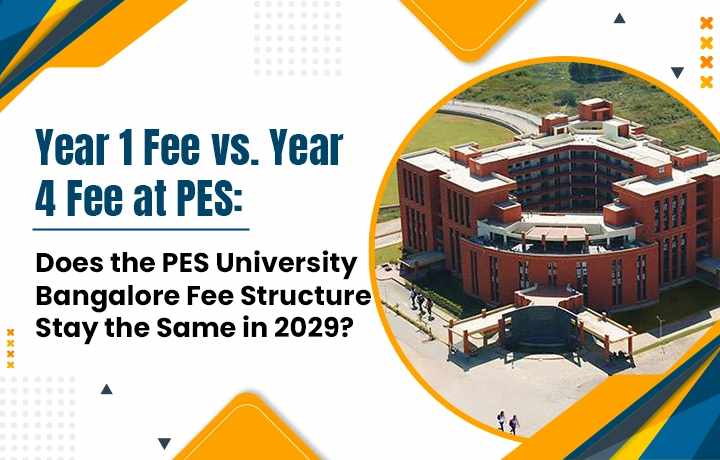
Year 1 Fee vs. Year 4 Fee at PES: Does the PES University Bangalore Fee Structure Stay the Same in 2029?
Jul 27, 2026
Picture this. You write a cheque of around ₹4 lakh in your first year at PES, feel that small wave of relief, and quietly do the math in your head. Four years, sixteen lakh, done. You've mentally boxed the entire BTech budget.
Then Year 2 arrives. A new fee circular shows up in the parent WhatsApp group. Somebody's mother asks, "Wait, is this more than last year?" And just like that, the neat plan you'd built starts to wobble.
This is the moment most families realize nobody actually explained the PES University Bangalore fee structure to them the way they needed to hear it. Not as a one-year quote. As a four-year commitment.
If you're about to write that first cheque, or you're already inside PES wondering what the next three years will really cost, this is the honest breakdown you've been looking for.
Why the Year 1 fee is almost never the "real" fee
Every private university in India, PES included, publishes a first-year fee. It's the number on the brochure. The one admission counsellors quote on calls. The one printed on your first fee slip. And it feels solid until you realize what's actually inside it.
What most families miss is that this figure bundles in one-time components you'll pay only once. Admission fee. Caution deposit. University registration. ID card. Orientation charges. All of these sit inside the Year 1 number and quietly disappear from Year 2 onwards.
So the "₹X per year" that families multiply by four is inflated at the start by items that won't repeat. But the flip side is equally true. Some components tend to rise every year. Tuition itself may see a small annual revision. Hostel and mess charges are almost always adjusted upward for inflation. Even exam and lab fees can shift.
The PES University Bangalore fee structure, like most private and deemed universities in Karnataka, is a moving figure. Not a locked one. You can check the current published fees for each program on the official PES University admissions page (pes.edu/admissions), but treat those numbers as the starting point, not the final one.
What usually stays fixed vs. what changes
Here's how to mentally split the four-year cost.
Usually one-time (paid only in Year 1): admission fee, refundable caution deposit, university registration, ID card, orientation.
Usually annual and often revised: tuition fee (small percentage hikes are common at most private universities), hostel rent, mess and food charges, transport if opted for, and semester exam fees.
Usually optional but real: specialized electives from Year 2 onward, industry certifications, foreign language add-ons, and study-abroad semesters. These don't appear in the Year 1 brochure, but they do land on your bill later if your child opts in.
The takeaway is simple. The number you paid in 2026 will almost certainly not be the exact number you pay in 2029. Whether the gap feels small or stressful depends entirely on what you ask before joining.
How to actually forecast your 4-year cost
Before you commit, sit down with the admissions office or with an experienced consultant, and get clear written answers to these five questions:
- Is there a written policy on annual fee revision, and what's the maximum yearly increase?
- How have hostel and mess charges moved over the last three years?
- Is the caution deposit fully refundable, and under what conditions?
- Are there any fixed-fee or one-shot schemes where Year 1 tuition is locked for all four years?
- What later-year charges (placement fee, alumni fee, and convocation fee) should you budget for?
If the university can't give clean answers to these, that itself is a signal worth listening to. Well-run institutions publish fee revision policies openly. The PES University Bangalore fee structure is documented on the official website, but the fine print (annual revision clauses, refund conditions, and hostel escalation) is where families should push for specifics before signing anything. The UGC's public complaint portal (ugc.gov.in) is also a useful reference if you ever feel a fee revision has crossed reasonable limits.
A smarter way to budget for all 4 years
Instead of budgeting the year 1 fee × 4, build a realistic projection with a 5 to 8 percent annual buffer on tuition and the hostel. That range covers most private universities in India historically, and it prevents the Year 3 shock that catches so many families off guard.
Also plan for the costs that never appear on the fee slip:
- Weekend food, travel home, and medical expenses.
- Laptop upgrades, books, and paid software.
- Placement season costs like formals, travel for interviews, and certification exams.
- Optional international exposure programs, if your branch offers them.
Add roughly 15 to 20 percent on top of the sticker fee, and you'll have a budget that survives all four years without last-minute loans or quiet stress at the dinner table.
If a fee hike happens mid-course, what are your options?
Fee revisions during your course are legal and standard. But you're not powerless when they happen.
Education loan top-ups are usually easy to arrange with your existing bank. The Vidya Lakshmi portal by the Government of India (vidyalakshmi.co.in) lets you compare and apply to multiple banks for education loans in one place, which is useful when the total cost creeps up.
Section 80E of the Income Tax Act lets parents claim the interest paid on an education loan as a deduction, with no upper limit on the amount, for up to 8 years. You can read the exact provision on the official Income Tax portal (incometax.gov.in). It meaningfully softens the impact of a mid-course fee hike.
Merit scholarships often kick in from Year 2 based on CGPA, so strong academic performance has direct financial value. National scholarship options are also listed on the government's National Scholarship Portal (scholarships.gov.in).
And if hostel fees rise sharply in later years, moving to a nearby PG is an option many senior PES students quietly take.
The honest answer
No. The number you paid in 2026 will not be the same in 2029. At CollegeDhundo, we've helped hundreds of families walk into PES with a full four-year cost picture, not just a year 1 estimate. If you want a clear, no-guesswork breakdown of the PES University Bangalore fee structure for the specific branch, campus, and category you're considering, our team is here to walk you through it.
Frequently Asked Questions
1. Does the PES University Bangalore fee structure stay the same for all 4 years of BTech?
No. Tuition, hostel, and mess charges are usually revised every year, and Year 1 includes one-time fees that don't repeat.
2. How much do PES university fees usually increase each year?
Private universities in Karnataka typically see 5 to 10 percent annual hikes in tuition and hostel charges.
3. Are hostel and mess charges part of the PES University Bangalore fee structure on the website?
No. They're listed separately and revised annually, so budget them as extra line items.
4. Can PES fees be paid in semester-wise installments?
Yes, for some programs and categories. Confirm the schedule during fee counseling.
Recent Post
-
-

-

-
-
-

-
-

-
-

-
-
-
-
.jpeg)
-
-

Common Mistakes Students Make During MBBS Admissions
Oct 17, 2025 -

-
-
-
-
-
.png)
-
-
.jpg)
-

-

-

-

-

-

-
.jpg)
-

-

-

-

-

-

-
-
-

-
-
-
-

-
-
-
-
-
A complete guide to direct admission in VIT Vellore
Feb 22, 2023 -
An Evaluation of SP Jain's MBA admission
Feb 15, 2023 -

-
-

-
-
-
Want to study MBA in Welingkar Mumbai?
Dec 20, 2022 -

-
A detailed study of DY Patil Medical College Pune
Dec 07, 2022 -
-

Tips to follow by considering CMAT Exam date
Nov 22, 2022 -

How should you choose GMAT exam dates?
Nov 22, 2022 -
An evaluation of Oxford Medical College Bangalore
Nov 17, 2022 -
-
Details for obtaining admission in IMT Ghaziabad
Nov 12, 2022 -
Geetanjali Medical College in Udaipur
Nov 09, 2022 -
Bharati Vidyapeeth Medical College Pune
Nov 23, 2022 -
-
Best colleges in Bangalore for engineering
Jul 18, 2022 -
Nitte Meenakshi Institute of Technology
Jul 14, 2022 -
Reva University Bangalore- Btech
Jul 07, 2022 -
Top law colleges in Bangalore
Jun 17, 2022 -
Best Colleges in Bangalore for commerce
Jun 15, 2022 -

New Horizon College of Engineering
Jun 14, 2022 -
BMS College of Engineering
Apr 27, 2022 -
Presidency University, Bangalore
Apr 23, 2022 -

Top MCA Colleges in Bangalore
Apr 04, 2022 -
BEST BBA COLLEGS IN BANGALORE
Mar 29, 2022 -
UPES B.tech Admission 2022
Mar 28, 2022 -
Top BCA colleges in Bangalore
Mar 07, 2022 -
Kempegowda Institute of Medical Sciences, Bangalore
Nov 29, 2021 -

Study MBBS Abroad at Low Cost
Aug 17, 2021 -
Direct admission in Kasturba medical college Manipal
Aug 09, 2021 -
.jpg)
Direct Admission in Jamia Hamdard
Aug 05, 2021 -
Direct Admission in Sharda Medical College
Aug 03, 2021 -
MS Ramaiah Engineering College
Aug 03, 2021 -
Direct admission in Vydehi Medical College
Jul 30, 2021 -
MS Ramaiah Medical College
Jul 29, 2021 -
Direct admission in BMS College of Engineering
Jul 27, 2021 -
Direct admission in KIMS Medical College Bangalore
Jul 26, 2021 -
-
RV College of Engineering Bangalore
Jul 19, 2021
